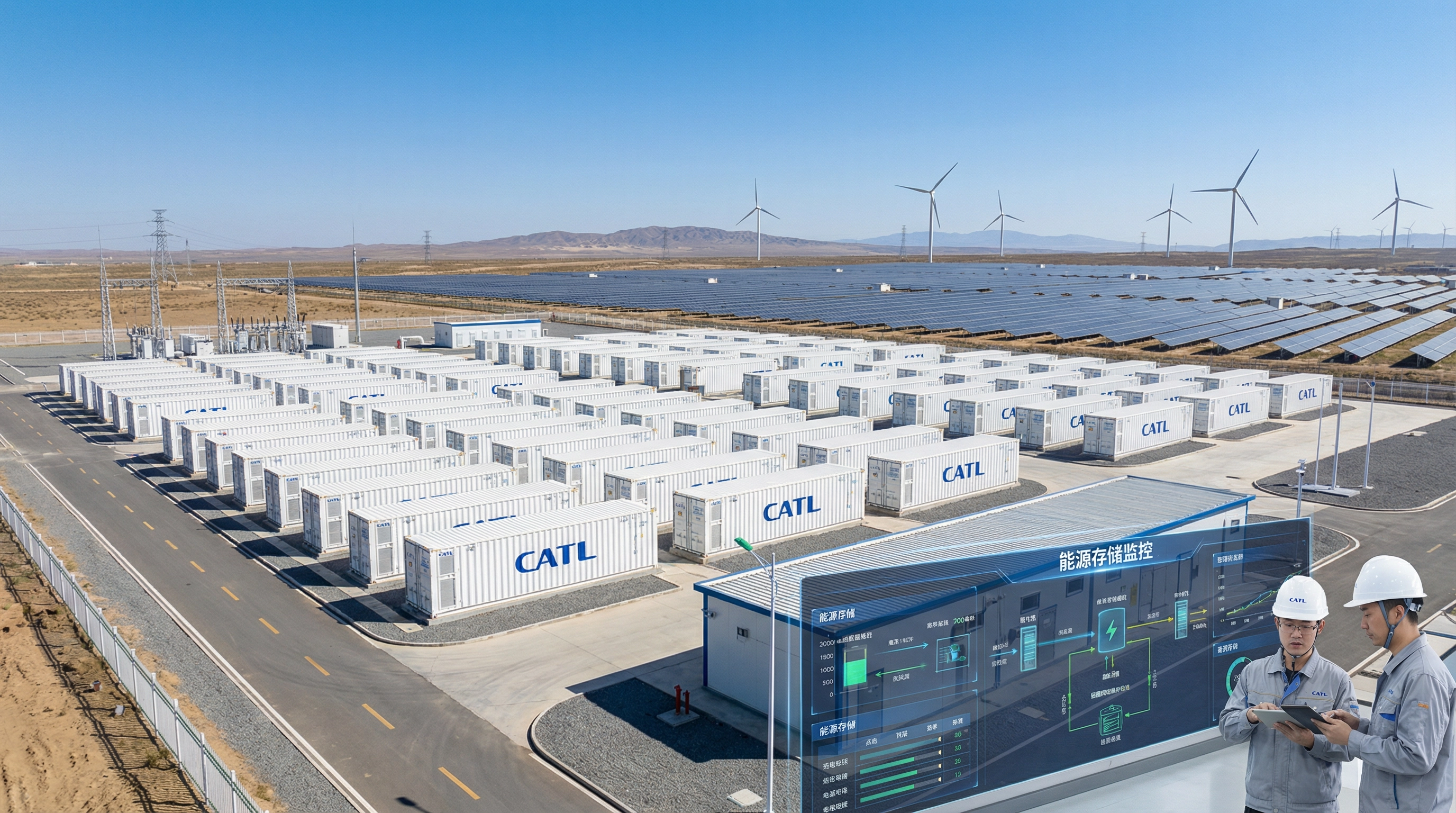
China controls approximately 80% of global battery production capacity, a dominance that extends beyond electric vehicles into stationary energy storage systems. This leadership in battery manufacturing, combined with aggressive deployment of grid-scale and residential storage, positions China as the central player in the global energy storage market.
CATL's Energy Storage Systems
Contemporary Amperex Technology Co. Limited (CATL) has expanded beyond EV batteries into comprehensive energy storage solutions. The company's Tener product line includes systems ranging from residential units (5-20 kWh) to utility-scale installations (100+ MWh). These systems utilize the same lithium iron phosphate (LFP) chemistry proven in millions of EVs, offering 6,000+ cycle lifetimes and enhanced safety.
CATL's grid-scale projects demonstrate the company's technical capabilities. A 300 MWh installation in Shandong Province provides frequency regulation and peak shaving services, stabilizing the grid while generating revenue through electricity arbitrage. The system charges during periods of low electricity prices (often when renewable generation exceeds demand) and discharges during peak price periods, capturing price differentials while supporting grid stability.
BYD's Residential and Commercial Solutions
BYD's energy storage division offers products spanning residential, commercial, and utility applications. The company's Battery-Box residential systems integrate with solar installations, storing excess solar generation for evening use and providing backup power during outages. Modular design allows capacity expansion as energy needs grow, with systems scaling from 5 kWh to 50+ kWh.
Commercial and industrial customers represent a growing market segment for BYD's storage systems. Factories and commercial buildings use storage to reduce demand charges (fees based on peak power consumption) by discharging batteries during high-demand periods. This application delivers rapid payback periods—often under three years—making storage economically attractive without subsidies.
Cost Advantages Driving Adoption
Chinese battery costs have declined to approximately $60-80 per kWh for utility-scale systems, compared to $100-150 per kWh for Western competitors. This cost advantage stems from vertical integration, manufacturing scale, and lower labor costs. CATL and BYD produce cathode materials, cell components, and complete systems in-house, capturing margins at each value chain stage while ensuring supply security.
The cost trajectory continues downward. CATL targets $50 per kWh by 2025 for utility-scale systems, a price point that makes storage economically viable for a much broader range of applications. At these costs, storage can replace natural gas peaker plants for grid reliability, fundamentally altering electricity market economics.
Grid-Scale Deployment in China
China has installed over 50 GWh of grid-scale battery storage, more than the rest of the world combined. Government mandates requiring renewable energy projects to include storage (typically 10-20% of generation capacity for 2-4 hours) drive deployment. These mandates ensure that wind and solar installations can provide dispatchable power, addressing intermittency concerns that limit renewable energy penetration.
Pumped hydro storage, while dominant globally, faces geographic and environmental constraints. Battery storage's flexibility—deployable anywhere with grid connection—enables distributed storage that provides localized grid support. This geographic flexibility is particularly valuable in urban areas where transmission constraints limit power delivery during peak demand.
Export Markets and Opportunities
Chinese energy storage systems are gaining traction in international markets. Europe, facing high electricity prices and ambitious renewable energy targets, represents a major market. Residential storage paired with solar installations has become economically attractive in Germany, Italy, and Spain, where Chinese systems dominate due to cost advantages.
Emerging markets with unreliable grid infrastructure find storage valuable for different reasons. In regions with frequent outages, battery systems provide backup power for critical loads. In areas with high diesel generator use, storage paired with solar can displace expensive diesel generation, delivering cost savings and emissions reductions.
Silk Route Materials facilitates procurement of Chinese energy storage systems for projects ranging from residential installations to utility-scale deployments. Our technical team can specify appropriate systems based on application requirements, verify product quality and certifications, and coordinate logistics. We work with CATL, BYD, and other leading manufacturers to provide reliable, cost-effective storage solutions.
Conclusion
China's dominance in battery manufacturing extends naturally into energy storage systems. The combination of low costs, proven technology, and massive production capacity positions Chinese manufacturers as the primary suppliers for the global energy storage market. As renewable energy deployment accelerates and storage becomes essential for grid stability, Chinese companies will capture the majority of this growing market. For businesses seeking energy storage solutions, Chinese manufacturers offer the most competitive and scalable options available. Silk Route Materials provides access to these manufacturers and the expertise necessary to successfully deploy Chinese storage systems in international markets.