
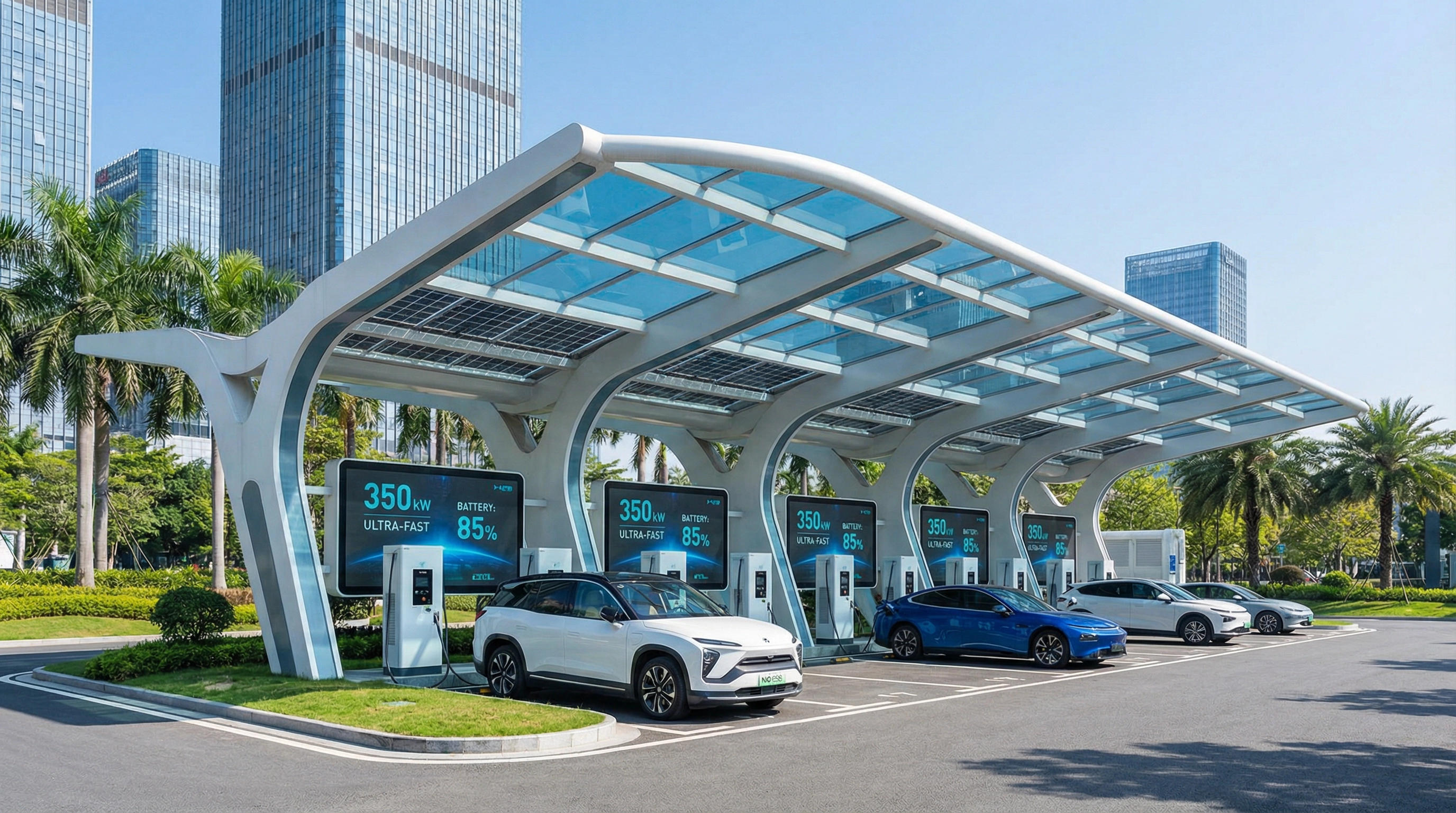
China has constructed the world's most extensive electric vehicle charging infrastructure, with over 2.6 million public charging stations as of 2024. This massive network, combined with technological innovations in ultra-fast charging and battery swap systems, addresses the primary barrier to EV adoption: charging convenience and speed.
The Scale of China's Charging Network
China's charging infrastructure deployment dwarfs other markets. The country accounts for approximately 60% of global public charging stations, with installations growing at over 50% annually. This rapid expansion reflects coordinated efforts between government policy, utility companies, and private charging network operators.
State Grid Corporation of China, the world's largest utility company, has installed hundreds of thousands of charging stations along highways and in urban areas. Private operators including Teld, Star Charge, and EV manufacturers' proprietary networks (NIO Power, Tesla Supercharger) complement public infrastructure, creating comprehensive coverage across major cities and intercity routes.
Ultra-Fast Charging: The 350kW Breakthrough
The latest generation of Chinese charging stations delivers up to 350kW power output, enabling 80% charge in 15-20 minutes for compatible vehicles. This charging speed approaches the refueling time of conventional vehicles, eliminating a key disadvantage of EVs for long-distance travel.
CATL, the world's largest battery manufacturer, has developed batteries capable of accepting these ultra-high charging rates without degradation. The company's Qilin battery achieves 4C charging capability, meaning a full charge in 15 minutes. This technological pairing—high-power chargers and high-rate batteries—solves the charging speed challenge that has limited EV adoption.
Liquid-cooled charging cables enable 350kW power delivery by preventing overheating during high-current charging sessions. Chinese manufacturers have standardized these systems, ensuring compatibility across different vehicle brands and charging networks. The GB/T charging standard, China's national standard, has evolved to support these power levels while maintaining backward compatibility with older vehicles.
Battery Swap: NIO's Alternative Approach
NIO has pioneered battery swap technology as an alternative to traditional charging. The company's swap stations replace a vehicle's depleted battery with a fully charged unit in under five minutes, faster than refueling a conventional car. Over 1,500 swap stations operate across China, with expansion into Europe underway.
The battery swap model offers several advantages beyond speed. Users can subscribe to battery services rather than purchasing batteries with vehicles, reducing upfront costs. Batteries can be charged during off-peak hours when electricity is cheaper and grid demand is lower, optimizing energy costs and grid utilization. Centralized battery charging enables better battery management and extends battery lifespan through controlled charging profiles.
Standardization challenges have limited battery swap adoption beyond NIO. Different vehicle architectures and battery designs prevent interoperability between brands. However, Chinese government initiatives to standardize battery dimensions and mounting systems could enable multi-brand swap networks, dramatically expanding the model's viability.
CATL: The Battery Innovation Leader
Contemporary Amperex Technology Co. Limited (CATL) has become synonymous with battery innovation. The company supplies batteries to virtually every major EV manufacturer globally, including Tesla, BMW, Volkswagen, and all Chinese EV brands. CATL's market share exceeds 35% of global EV battery production, with manufacturing capacity continuing to expand.
CATL's Qilin battery achieves 255 Wh/kg energy density, 13% higher than Tesla's 4680 cells. This density improvement translates directly to increased vehicle range without adding weight. The company's lithium iron phosphate (LFP) batteries offer cost advantages and enhanced safety compared to nickel-cobalt batteries, making EVs more affordable while maintaining acceptable range.
Sodium-ion batteries, CATL's latest innovation, address lithium supply constraints and cost concerns. While offering lower energy density than lithium batteries, sodium-ion technology uses abundant, inexpensive materials and performs better in cold weather. CATL plans mass production of sodium-ion batteries for entry-level EVs and energy storage applications.
Integration with Renewable Energy
China's charging infrastructure increasingly integrates with renewable energy sources. Solar canopies at charging stations generate electricity on-site, reducing grid demand and providing shade for parked vehicles. Battery energy storage systems at charging hubs store renewable energy and provide grid stabilization services, creating revenue streams beyond charging fees.
Vehicle-to-grid (V2G) technology, enabled by bidirectional chargers, allows EVs to discharge electricity back to the grid during peak demand periods. This capability transforms EVs from passive loads into distributed energy resources, supporting grid stability while providing vehicle owners with additional income. Chinese utilities are piloting V2G programs in several cities, with plans for nationwide deployment.
Export Opportunities for Charging Equipment
Chinese manufacturers dominate global charging equipment production, offering products at prices 40-60% below Western competitors. Companies like Teld, Star Charge, and Envision produce chargers ranging from 7kW AC units for home installation to 350kW DC fast chargers for commercial applications.
Quality has improved dramatically, with leading Chinese chargers meeting international safety and performance standards. CE certification for European markets and UL certification for North America enable Chinese equipment to compete in developed markets. Emerging markets with nascent EV infrastructure represent primary opportunities, where cost advantages are decisive.
Silk Route Materials facilitates procurement of Chinese charging equipment for international projects. Our technical team can specify appropriate equipment for specific applications, verify quality and certifications, and coordinate logistics. From small-scale installations to large charging networks, we provide comprehensive sourcing solutions for EV infrastructure development.
Conclusion
China's EV charging infrastructure and battery technology leadership create a comprehensive ecosystem supporting electric mobility. The combination of extensive charging networks, ultra-fast charging capabilities, innovative battery swap systems, and world-leading battery manufacturing positions China at the forefront of the global EV transition. For businesses developing EV infrastructure or seeking charging equipment, Chinese manufacturers offer proven technology at competitive prices. Silk Route Materials provides access to this ecosystem, enabling efficient procurement and deployment of EV charging solutions.